Pretty Goes Global: China, Curiosity, and the Strange Journey of a Dog With Buttons

There are moments in a small research project when reality becomes wonderfully disproportionate.
At Canine Communication Research, we are used to watching small things carefully: a paw near a button, a dog looking at a door, a hesitation before a press, a yawn after reassurance, a bark becoming quieter at night.
Small signals.Small contexts.Small domestic events.
And then, suddenly, the world map lights up.
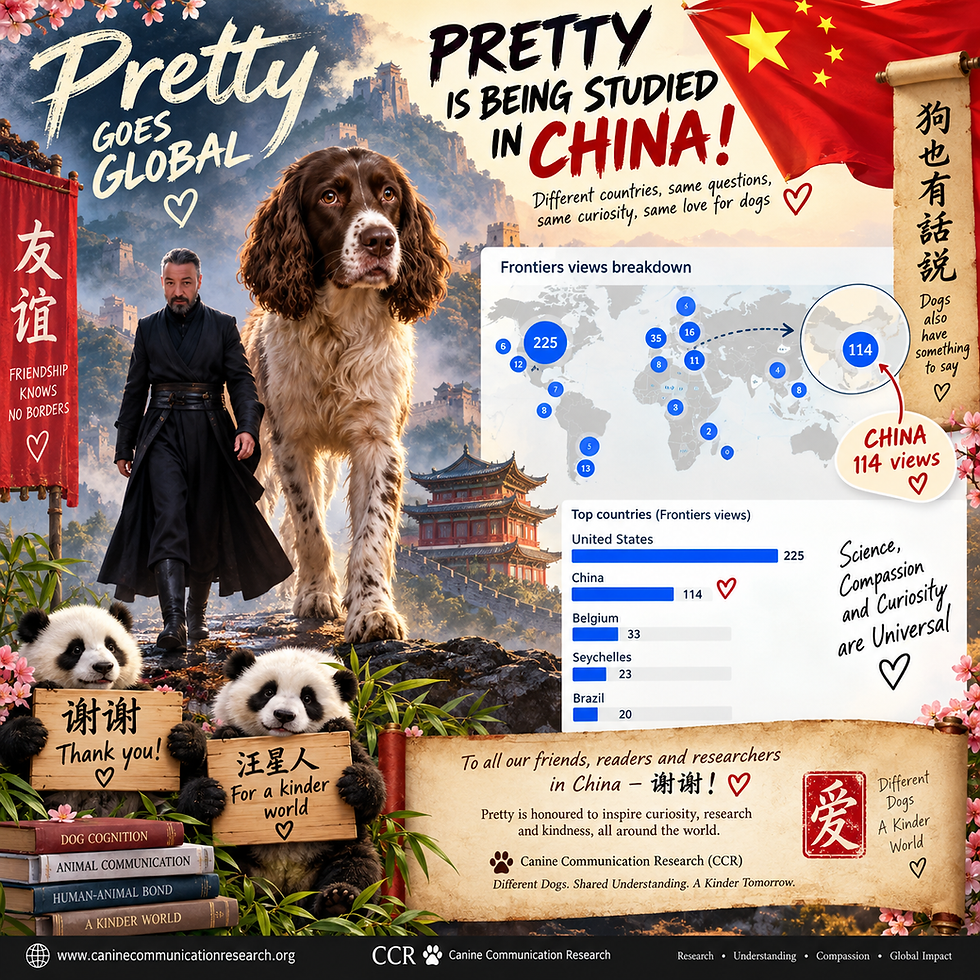
Following the publication of our Frontiers article, From Button Presses to Situated Communicative Events, we looked at the early viewing statistics and noticed something delightful: the article is already being read internationally.
The United States is currently leading the views. That is not surprising given the visibility of canine soundboard research and the public interest around “talking dogs.”
But then came the surprise:
China is already the second country in article views.
For a project born in a household in Rebecq, around Pretty the Springer Spaniel and her soundboard buttons, that is a beautiful moment.
A Small Dog, a Global Question
The article does not claim that dogs “talk like humans.”
That has always been important.
CCR is not built on spectacle. It is not about turning dogs into little furry philosophers with dramatic subtitles and viral expectations. The work is much more cautious, and for that reason, we hope, more useful.
The paper asks a different question:
What if the real unit of analysis is not the isolated button press, but the situated communicative event around it?
That means: not just the button.Not just the word.Not just the recording.
But the whole event:
what happened before;
where the dog was;
what the dog was looking at;
what the human did;
what the environment made possible;
what alternative explanation must still be considered;
what happened after.
This is the methodological core of the paper. It is also the reason the international response feels meaningful.
Because the question is not Belgian.It is not American.It is not Chinese.It is not limited to one platform, one dog, or one household.
It belongs to everyone who has ever looked at an animal and wondered:
“Did I understand you correctly?”
Why China Matters Here
Seeing China appear so strongly in the early statistics is touching because the question of animal communication is profoundly cross-cultural.
Different societies may frame animals differently. Different languages may carry different assumptions about mind, speech, obedience, affection, and companionship. But the core experience is universal: humans live with animals, observe them, misread them, love them, train them, project onto them, and sometimes — if we are patient — learn from them.
Pretty’s story is not important because she is exceptional in a theatrical sense.
She is important because she forces a methodological discipline:
Do not overclaim.Do not dismiss.Look again.Record the context.Allow ambiguity.Respect the animal.Let the evidence breathe.
That message can travel.
And apparently, it has already started to.
Pretty’s Official Position
Pretty herself has not yet issued a formal statement on her readership in China.
However, based on prior field observations, we can cautiously reconstruct a possible response:
“Outside.”“Love-you-Dad.”“Snack.”“Why are people looking at my buttons?” “Also, is the garden available?”
This interpretation remains tentative and should be treated with appropriate methodological humility.
Still, one may reasonably suspect that Pretty would approve of international attention if it came with calm voices, gentle handling, and possibly biscuits.
From Haverim to the World
CCR began as a home-based inquiry into canine communication, welfare, and interpretation.
At Haverim, communication does not only happen through buttons. It also happens through bodies, routines, refusals, anxieties, rituals, doorbells, whisper-barks, and the patient negotiation of everyday life with dogs.
Pretty’s buttons opened one door.
Chanel’s bell-ringing opens another.
Lilly and Elvis taught us that cleanliness can sometimes be a diplomatic treaty.
And now, the Frontiers article gives us a scientific frame for saying what we have slowly learned:
communication is not just a signal. It is an event.
It happens between beings.It happens in context.It happens with uncertainty.It requires interpretation.And interpretation requires responsibility.
Thank You to Our Readers
So today we simply want to say thank you.
Thank you to readers in the United States.Thank you to readers in China.Thank you to readers in Belgium, Seychelles, Brazil, and everywhere else the article is travelling.
Thank you to researchers, dog guardians, animal-welfare people, citizen scientists, sceptics, enthusiasts, and anyone willing to think carefully about what dogs may be trying to do when they use buttons — or when they communicate without them.
The article is only one step.
But it is a serious step.
From a small home lab in Walloon Brabant, Pretty’s world has begun to travel.
And somewhere between a paw, a button, a human response, and a global map of readers, CCR has found a very simple reason to celebrate:
Different countries. Same curiosity. Same love for dogs. Same responsibility to listen well.
Pretty has gone global.
Now we must make sure the science remains worthy of her.


Comments