The Sausage Party Protocol: How Two Senior Tiny Tyrants Became Clean at Haverim
- Gavriel Wayenberg
- 10 minutes ago
- 3 min read

At Haverim keLev, behavioural diplomacy sometimes arrives in the form of a sliced sausage.
Lilly and Elvis came to us with the majestic authority of elderly small dogs. Lilly, the dwarf teckel, had the focused determination of a tiny underground engineer doubled by an all-out-barking grass torpedo. Elvis, the fluffy chihuahua aka d'Artagnan, carried the emotional sensitivity of a velvet security alarm. Together, they formed a senior diplomatic bloc of considerable power.
The mission was simple on paper and ancient in practice: no pee, no poop inside.
Not through shouting. Not through guilt. Not through dramatic accusations at 7 a.m. in the kitchen. Through something much more powerful: clarity, fairness, ritual, and a reward small enough to fit in the hand but large enough to rearrange the moral universe.
Thus was born the Sausage Party Protocol.

Image: The Storyline - with our button-champion Springer Pretty, an applied methodology for success.
The procedure was simple. A tasty reward was prepared, visibly divided, and shared equally. The rule was stated calmly: clean behaviour opens the ceremony; indoor accidents close it. No anger. No humiliation. No lecture. No “who did this?” courtroom drama. Just a clear, stable, repeatable contract.
And here is the important methodological point: the reward was not merely food. It was timing, fairness, eye contact, social order, and recognition. Lilly and Elvis were not bribed randomly. They were included in a ritual they could understand.
The result was spectacular. Since 9 July, while hosted at Haverim, not a single indoor poop or pee has been recorded. The certificate awarded to Lilly and Elvis — “Propreté Senior – Niveau Diplomatie Avancée” — began as joyful humour, but it is now backed by stable observed behaviour.
What happened here?
At CCR, we do not interpret this as magic. Nor do we interpret it as dominance. We interpret it as communication under structured conditions.
First, the rule was clear. Dogs do not need a philosophical thesis, but they do need consistency. A household that changes tone, timing, reward, access, and expectations every day becomes unreadable. A readable household becomes learnable.
Second, the ritual was fair. Lilly and Elvis were treated together. No favouritism. No suspicious unequal distribution. No tiny-dog political scandal. The reward ceremony made justice visible.
Third, the emotional frame was calm. Senior dogs are not machines. They are sensitive animals, often carrying habits, anxieties, pride, and very strong opinions about comfort. Pressure can produce resistance. Diplomacy can produce cooperation.
Fourth, the behaviour was not isolated from context. Cleanliness depends on timing, outdoor access, night structure, owner response, inspection rituals, and the emotional climate of the home. A pee is not only a pee. It is also a data point in a household system.
This is why we call the method “cleanliness diplomacy.” It is not just training. It is the creation of a small social treaty between humans and dogs.
There is, however, an important public-health footnote hidden under the comedy. The “sausage party” is the story-name, not the literal recommendation. In future CCR teaching, the reward must be dog-safe, adapted to the individual animal, and free from dangerous ingredients such as garlic, onion, or spicy sauces. The scientific core is not the sausage. The scientific core is ritualized equitable reinforcement.
The next mission has already begun: night barking diplomacy. The same principles apply. Clear hours. Calm rules. No panic. No yelling contest at 3 a.m. No apocalyptic interpretation of every bark. Just gradual behavioural negotiation between species.
The elderly small-dog parliament has not fully ratified that treaty yet, but negotiations are progressing.
So yes: Lilly and Elvis passed.
Not because they were dominated. Not because they were frightened. Not because they were tricked. They passed because they were treated as intelligent partners capable of understanding a fair rule.
That is the Haverim lesson.
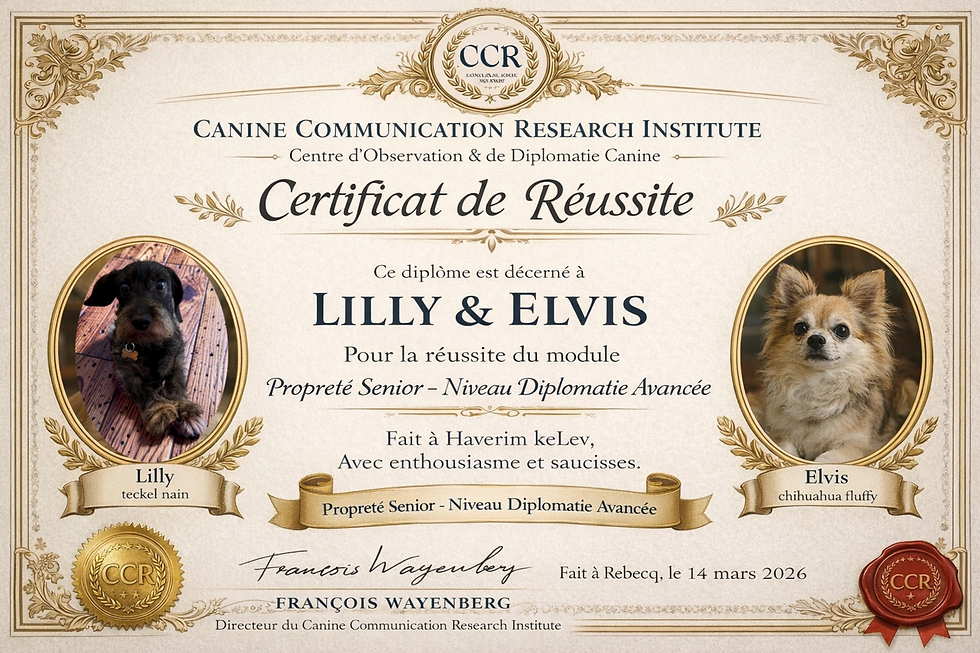
Image: the CCR certificate received by the owners of Lilly and Elvis (French) for the achievement of cleanliness.
Sometimes, behaviour changes when the household becomes readable. Sometimes, dignity works better than pressure. And sometimes, at the frontier between comedy and methodology, two senior dogs become ambassadors of cleanliness before the mighty tribunal of sausage.
Yours Faithfully,
The CCR Sausage-Rehab Team


Comments