The Silent Double Sausage Party
- Gavriel Wayenberg
- May 9
- 3 min read

Or: how three senior dogs accidentally discovered comparative grammar at dawn

At the CCR, we are beginning to suspect that senior dogs, when properly motivated, can become unexpectedly attentive students of both mathematics and comparative linguistics.
This morning’s lesson was particularly extraordinary because it unfolded almost entirely in silence.
No barking.
No whining.
No diplomatic incidents.
Only concentration.
And sausages.
Lots of concentration about sausages.
The setting
The morning began with what can only be described as a highly ceremonial atmosphere.
The kitchen lights were soft.
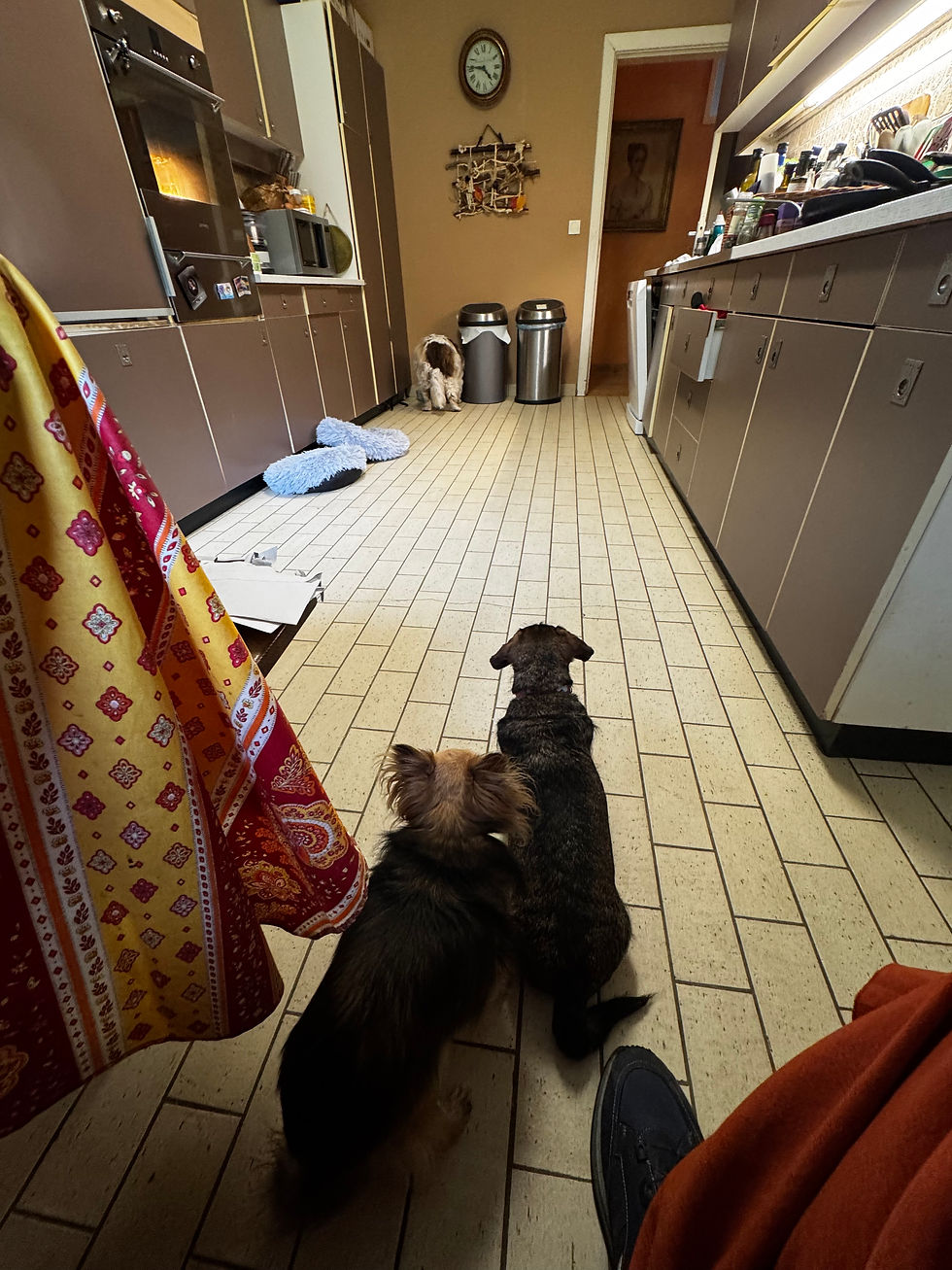
The pack was assembled.
The stakes were enormous.
Present:
Pretty the English Springer Spaniel,
Lilly the wire-haired dwarf teckel,
Elvis the fluffy long-haired Chihuahua gentleman.
The three elders had voluntarily formed what at CCR we now call:
a “retirement wolfpack.”
This is scientifically important.
Pretty normally has free access to the entire house and often sleeps in the living room near the communication board. Yet she explicitly requested to join the smallies in the kitchen during these educational sausage sessions.
Why?
Because the social ritual itself had become meaningful.
The sausage party was no longer merely nutritional.
It had become:
pedagogical,
diplomatic,
emotional,
and apparently academic.
The lesson topic:
“Greater than.”
This was advanced material.
The first comparison introduced was relatively uncontroversial:
Auntie Coco’s cooking is very good.
The dogs all agreed.
But…
the sausages are better.
This led naturally to the first great theorem of the morning:
Sausages > Popote.
The conclusion was accepted unanimously by the entire canine faculty.
No peer review objections were raised.
The forbidden comparative subject
Then came a much more delicate topic.
One that every senior dog understands instinctively…
but prefers not to discuss openly.
The distribution ratio.
Because, naturally:
Elvis is tiny,
Lilly is medium-small,
Pretty is significantly larger.
And therefore:
sausage fragment size must be proportional to dog size.
Which mathematically produced the following relationship:
Elvis < Lilly << Pretty
A socially dangerous equation.
Especially among seniors with long life experience and strong opinions about fairness.
The atmosphere became extremely serious.
All three dogs observed the distribution process with forensic attention.
One could almost hear the internal calculations occurring.
Especially from Elvis.
Who, despite his miniature size, possesses the moral vigilance of a retired tax auditor.
The miracle:
no conflict
Now this is where the event became scientifically fascinating.
Because despite the unequal sausage sizes…
there was:
no jealousy,
no growling,
no theft attempt,
no diplomatic collapse.
Why?
Because the logic had been clearly explained beforehand.
This supports one of the central observations repeatedly emerging at the CCR:
senior dogs tolerate inequality surprisingly well when:
the rule is stable,
the rationale is understandable,
and the process is perceived as fair.
In other words:
Dogs may not demand equality.
But they deeply appreciate coherence.
Concentration proportional to interest
As the lesson progressed, another extraordinary phenomenon appeared.
The more relevant the topic became to the dogs’ immediate interests…
the greater their concentration became.
The scientific principle observed this morning may therefore be summarized as:
Canine attention ∝ motivational relevance.
Or, in simpler CCR terminology:
“The more sausage-related the lesson, the smarter everybody suddenly becomes.”
Remarkable.
Scientific implications
This morning’s silent sausage seminar revealed several important elements about multi-dog cognition and social learning:
1. Comparative evaluation
The dogs clearly tracked:
quantity,
relative size,
sequencing,
and fairness.
2. Pack integration
Pretty voluntarily joining the kitchen cohort suggests:
socially motivated participation,
ritual belonging,
and group synchronization.
3. Rule-based tolerance
The dogs accepted unequal reward distribution because:
the proportional logic was stable,
and verbally contextualized.
This is particularly interesting in senior dogs.
4. Silent coordination
The absence of vocalization despite high excitement suggests:
inhibitory control,
ritual anticipation,
and learned behavioral structure.
Final conclusion from the Department of Applied Sausage Grammar
This morning, CCR officially demonstrated that:
sausages are superior to ordinary cuisine,
proportion matters,
fairness can be negotiated,
and elderly dogs become astonishingly attentive when advanced grammar intersects with processed chicken products.
Further studies are now planned regarding:
comparative philosophy,
advanced sausage economics,
and whether Elvis secretly believes redistribution policies discriminate against miniature dogs.
The wolfpack remains highly motivated.
Especially before breakfast.


Comments